
Dragon Name Generator
Dragons are among the most recognizable creatures in fantasy storytelling. Their names often reflect their power, appearance, personality, history, and connection with their riders. A memorable name can make a dragon feel like an important character rather than just another mythical creature.
Our Dragon Name Generator helps you explore original names for dragons in fantasy stories, role-playing games, fictional kingdoms, and creative projects. Whether you want a fierce name for a powerful fire-breathing beast or an elegant name for an ancient dragon, use the generator to discover ideas that fit your character.
Fans of Game of Thrones and House of the Dragon may also recognize names such as Balerion, Vhagar, Meraxes, Caraxes, and Drogon. These established dragon names provide excellent inspiration, although newly generated suggestions should not be confused with names from the official franchise.
If you are interested in the language behind the Targaryen world, you can also explore our High Valyrian translator, or find a rider for your dragon with the Targaryen name generator.
How to Use the Dragon Name Generator
Creating a dragon name does not require extensive knowledge of fantasy languages. A name generator provides a convenient starting point and helps you explore different combinations of sounds.
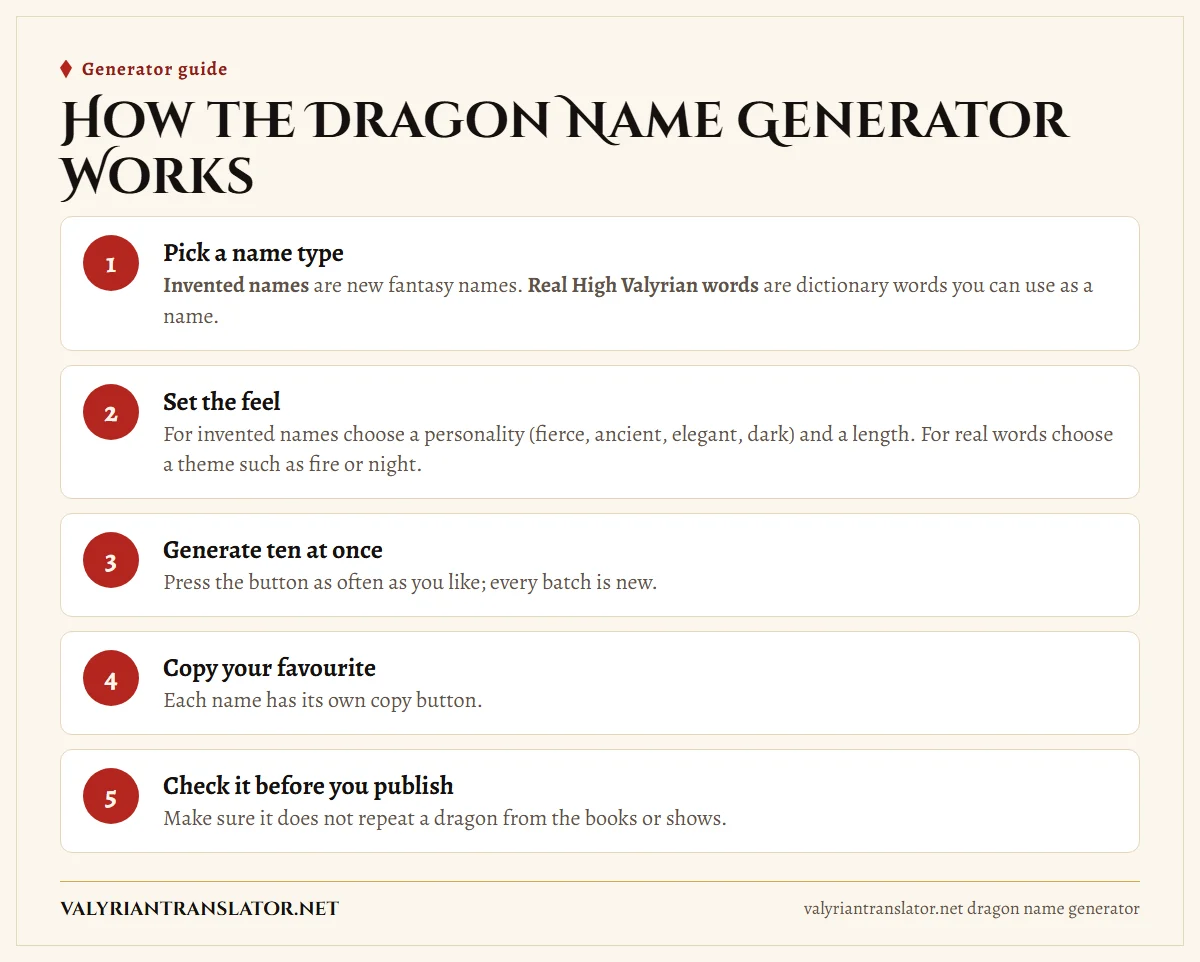
Follow these simple steps:
- Pick a name type: choose Invented fantasy names for brand-new names, or Real High Valyrian words for documented dictionary words you can use as a name.
- Consider your dragon: think about its personality, appearance, abilities, and role in your story, then set the Personality and Length (or the Theme for real words) to match.
- Generate name ideas: press the button to get ten suggestions at once. Press again for a fresh batch.
- Compare the suggestions: look for a name that matches your dragon's personality and background. Real words show their English meaning next to them.
- Choose your favorite: use the Copy button next to the name, and pick one that is easy to recognize, pronounce, and remember.
You can use the generated suggestions for original fantasy characters, tabletop adventures, gaming profiles, fictional creatures, and personal writing projects.
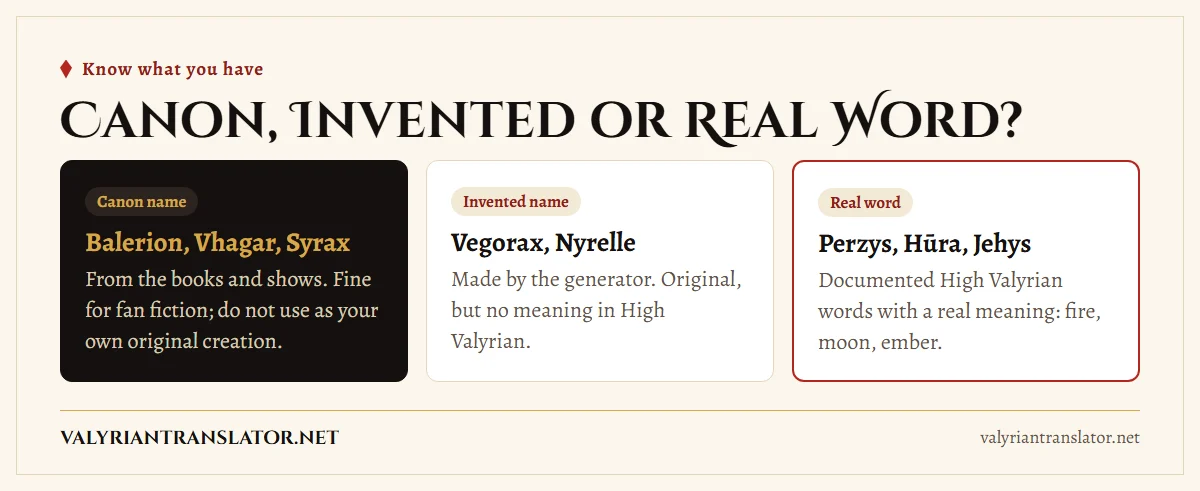
Remember that invented names are creative suggestions. They are not official names from Game of Thrones or translations from the documented High Valyrian language. The generator also filters out names already used by dragons and Targaryens in canon.
What Makes a Good Dragon Name?
A good dragon name should create a clear impression. When readers or players encounter it, they should get some sense of the creature's identity.
There is no universal naming formula for dragons. However, a few creative principles can help you select a suitable name.
1. Match the Name to the Dragon's Personality
Start by considering how your dragon behaves.
A fierce and aggressive dragon may suit a short, forceful name. A calm and intelligent creature could have a more elegant name. Ancient dragons may benefit from names that sound formal and imposing.
For example, a dragon that protects an ancient kingdom might need a different naming style from one known for destruction and battle.
2. Consider Its Physical Appearance
A dragon's physical features can provide useful naming inspiration. Think about its:
- Scale color and pattern.
- Size and wingspan.
- Horns, tail, and distinctive features.
- Fire or other special abilities.
- Age and overall appearance.
A black dragon might have a name inspired by darkness or shadows, while a golden dragon could have a name associated with sunlight, treasure, or royalty.
These are creative naming themes, not translations into High Valyrian.
3. Give the Dragon a Historical Connection
Some of the most interesting fantasy names have a story behind them.
A dragon might receive its name from an important ancestor, a legendary warrior, an ancient deity, or a historical event. This approach is especially useful when creating dragons for fictional royal families and powerful dynasties.
You can also connect a dragon's name to its rider, homeland, or the kingdom it protects.
4. Choose a Memorable Sound
Pronunciation matters when selecting a name.
Long names can create an impression of age and importance, while shorter names are often easier to remember. Repeated sounds and distinctive consonants can also help establish a recognizable naming style.
For a dragonlord-inspired fantasy setting, you may prefer names with formal, unusual combinations of sounds. However, sounding similar to a fictional language does not make a name part of that language.
Famous Dragon Names from Game of Thrones and House of the Dragon
The Game of Thrones franchise contains many dragons with distinct names, histories, and riders. Some were associated with the early Targaryen conquest, while others became important during the Dance of the Dragons or Daenerys Targaryen's journey.
Studying established names can help you understand how different dragons are identified throughout the fictional history.
| Dragon Name | Known Association | Notable Detail |
|---|---|---|
| Balerion | Aegon I Targaryen | Known as the Black Dread |
| Vhagar | Visenya, Laena Velaryon, and Aemond Targaryen | One of the oldest and largest dragons |
| Meraxes | Rhaenys Targaryen | One of the dragons used during Aegon's Conquest |
| Syrax | Rhaenyra Targaryen | A dragon closely associated with Rhaenyra |
| Caraxes | Daemon Targaryen | Known as the Blood Wyrm |
| Meleys | Rhaenys Targaryen | Known as the Red Queen |
| Sunfyre | Aegon II Targaryen | Recognized for its golden appearance |
| Dreamfyre | Rhaena Targaryen and later Helaena Targaryen | An important dragon in Targaryen history |
| Drogon | Daenerys Targaryen | Named after Khal Drogo |
| Rhaegal | Daenerys Targaryen | Named after Rhaegar Targaryen |
| Viserion | Daenerys Targaryen | Named after Viserys Targaryen |
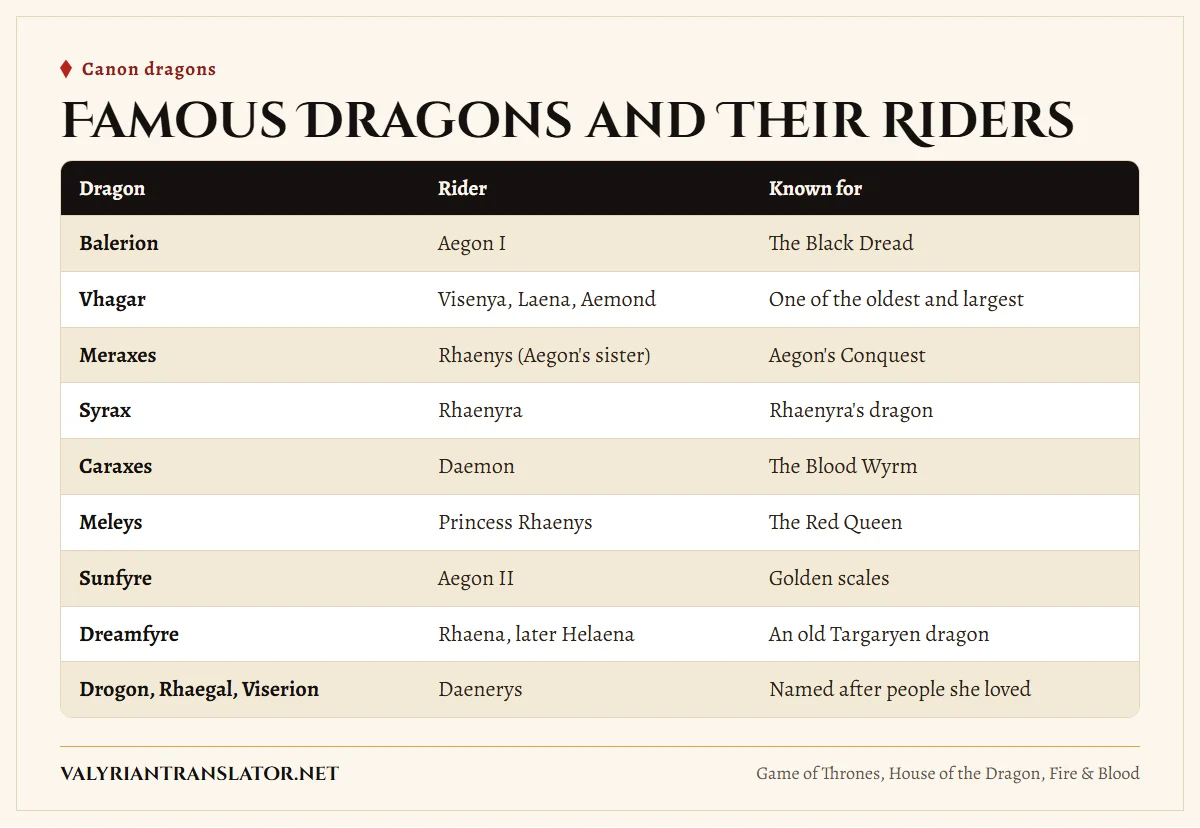
These are established fictional names, not outputs from a modern name generator.
The Naming History of Balerion, Vhagar, and Meraxes
Balerion, Vhagar, and Meraxes have a particularly interesting connection with the history of House Targaryen.
According to the established story, Aegon the Conqueror rode Balerion, Visenya rode Vhagar, and Rhaenys rode Meraxes. Their names are associated with the old gods of Valyria.
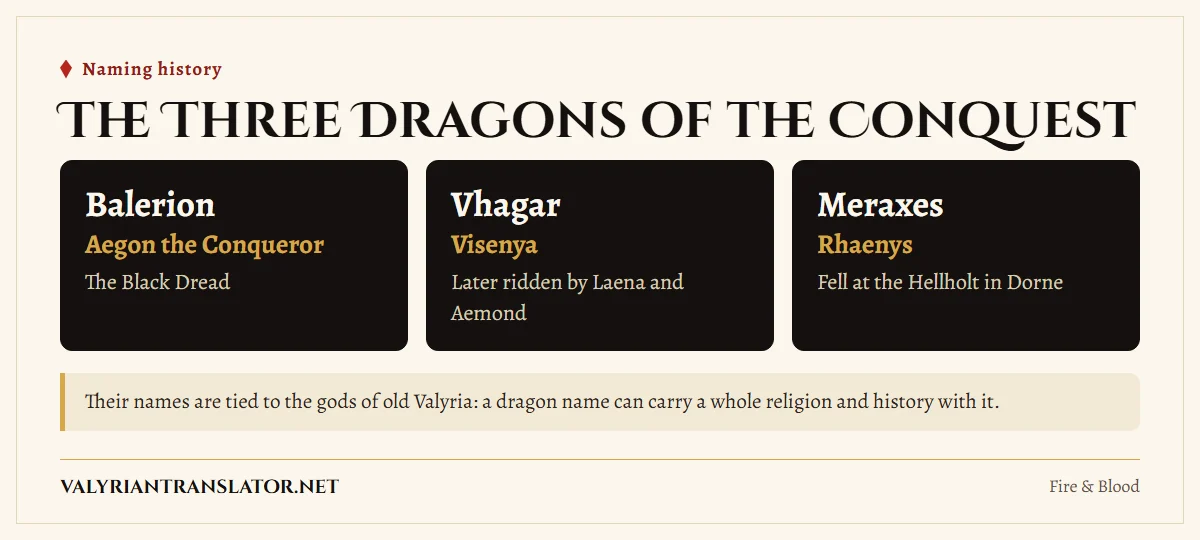
These dragons are closely connected with the Targaryen conquest of Westeros and the family's identity as dragonlords.
Their names demonstrate how fictional naming can connect a creature with a broader religious, historical, and cultural background.
Why Drogon, Rhaegal, and Viserion Have Their Names
Daenerys Targaryen's three dragons have names connected to people who were important in her life.
- Drogon: Named after Khal Drogo, her husband.
- Rhaegal: Named after Rhaegar Targaryen, her brother.
- Viserion: Named after Viserys Targaryen, her brother.
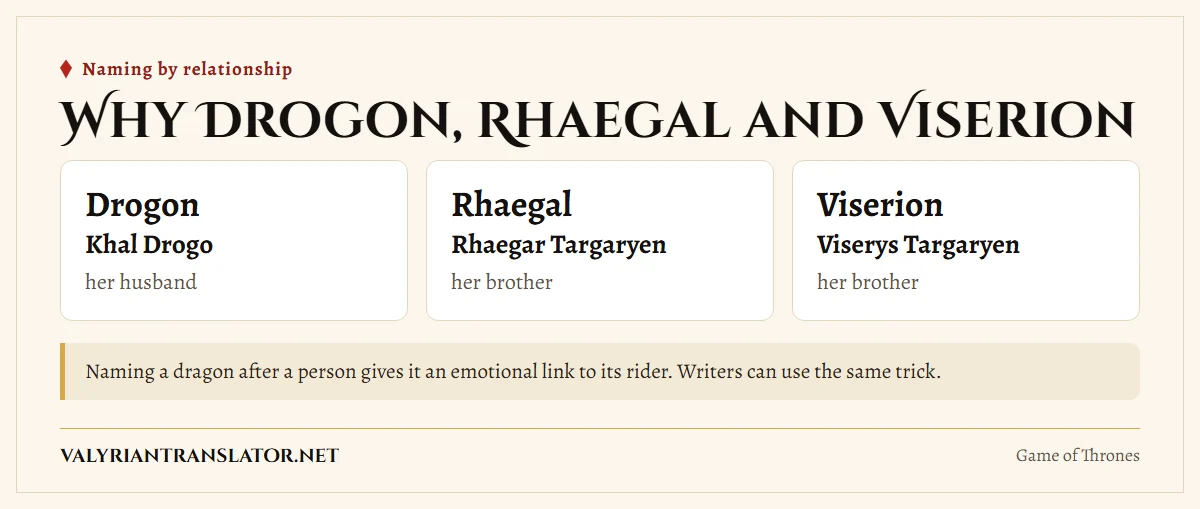
This is an example of naming through personal relationships rather than physical appearance or abilities.
For fantasy writers, the same idea can be used to establish an emotional connection between a dragon and its owner.
Dragon Name Ideas for Fantasy Stories
Sometimes you need a little inspiration before choosing a name. Looking at different naming styles can help you decide which direction suits your fictional creature.
The following are original fantasy-style examples created for inspiration. They are not established dragons from the books or television series, and they are not verified High Valyrian words.
| Creative Name | Suggested Character |
|---|---|
| Aevoryn | An ancient and noble dragon |
| Vaelthar | A powerful elder dragon |
| Zoryndra | An elegant and swift dragon |
| Morvax | A fierce and intimidating dragon |
| Thalerys | A calm and watchful dragon |
| Rhaezor | An aggressive battle dragon |
These examples have no claimed linguistic translations or canonical meanings. Their purpose is to illustrate how different sounds can create different impressions.
You can develop your own naming conventions by deciding which sounds, lengths, and combinations belong to the dragons in your fictional world.
Different Types of Dragon Names
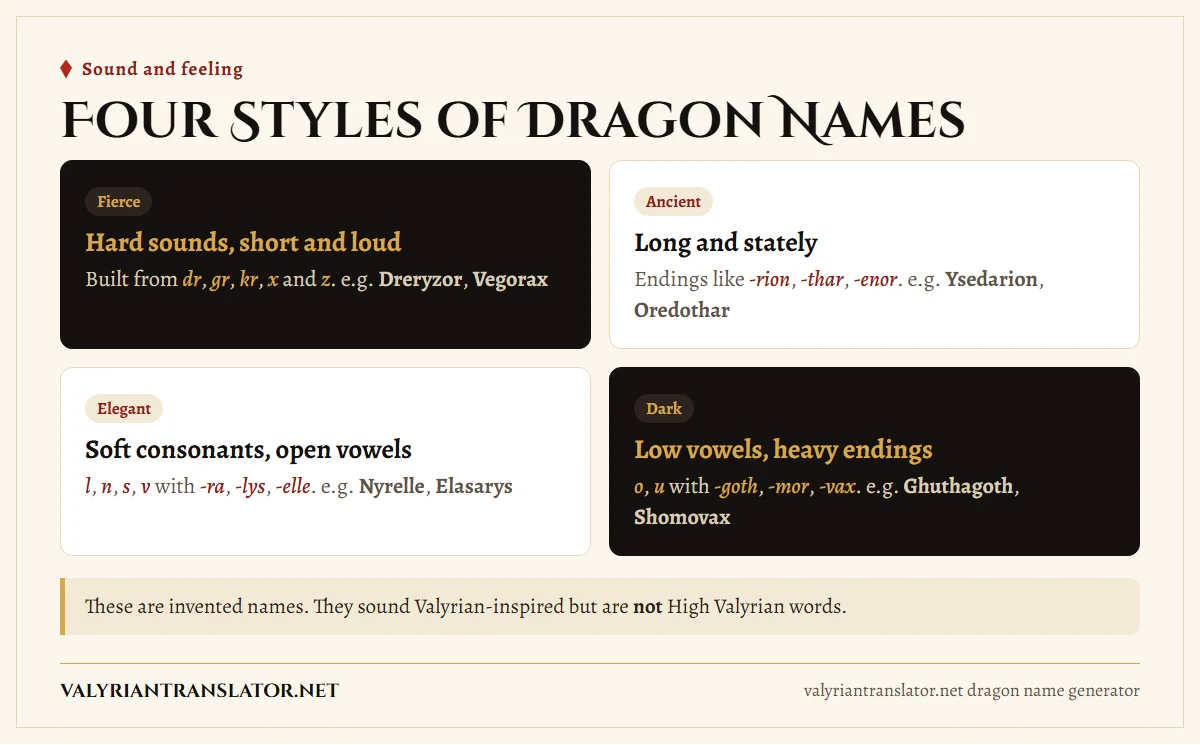
Not every dragon needs to sound intimidating. The right name depends on the creature's role and the type of fantasy setting in which it appears. The generator's four personalities follow the same idea.
Powerful and Fierce Dragon Names
Large dragons associated with destruction, warfare, or conquest often need strong-sounding names. These names work particularly well for:
- Ancient dragons.
- Battle companions.
- Fire-breathing creatures.
- Guardians of powerful kingdoms.
- Legendary beasts feared by entire armies.
A short, forceful name can make an aggressive character easier to recognize.
Ancient and Legendary Dragon Names
Some dragons have existed for centuries in their fictional worlds. Their names should reflect their history and importance. Consider names inspired by:
- Ancient civilizations.
- Lost kingdoms.
- Legendary rulers.
- Forgotten deities.
- Historical battles.
This style is suitable for fantasy novels, fictional histories, and role-playing campaigns involving powerful dragonlords.
Elegant and Noble Dragon Names
A dragon does not always have to represent violence. Some creatures may be associated with royalty, wisdom, loyalty, or protection.
Elegant names can work well for dragons that belong to royal families or serve as companions to important characters.
Dark and Mysterious Dragon Names
Dragons associated with abandoned kingdoms, hidden caves, dark magic, or ancient legends may benefit from mysterious-sounding names. You can experiment with names inspired by:
- Shadows and darkness.
- Storms and cold winds.
- Forgotten lands.
- Night skies.
- Ancient ruins.
These are creative themes rather than established naming rules.
Are Dragon Names in Game of Thrones Written in High Valyrian?
Not every dragon name from Game of Thrones or House of the Dragon should automatically be considered a documented High Valyrian word.
This distinction is important because George R. R. Martin introduced Valyrian names and expressions in his books before David J. Peterson developed the expanded High Valyrian language for HBO.
Peterson used the existing material as a starting point and developed a more complete linguistic system with its own vocabulary, grammar, and pronunciation.
Consequently, a name that looks or sounds Valyrian is not necessarily an ordinary word in the language.
What Is the High Valyrian Word for Dragon?
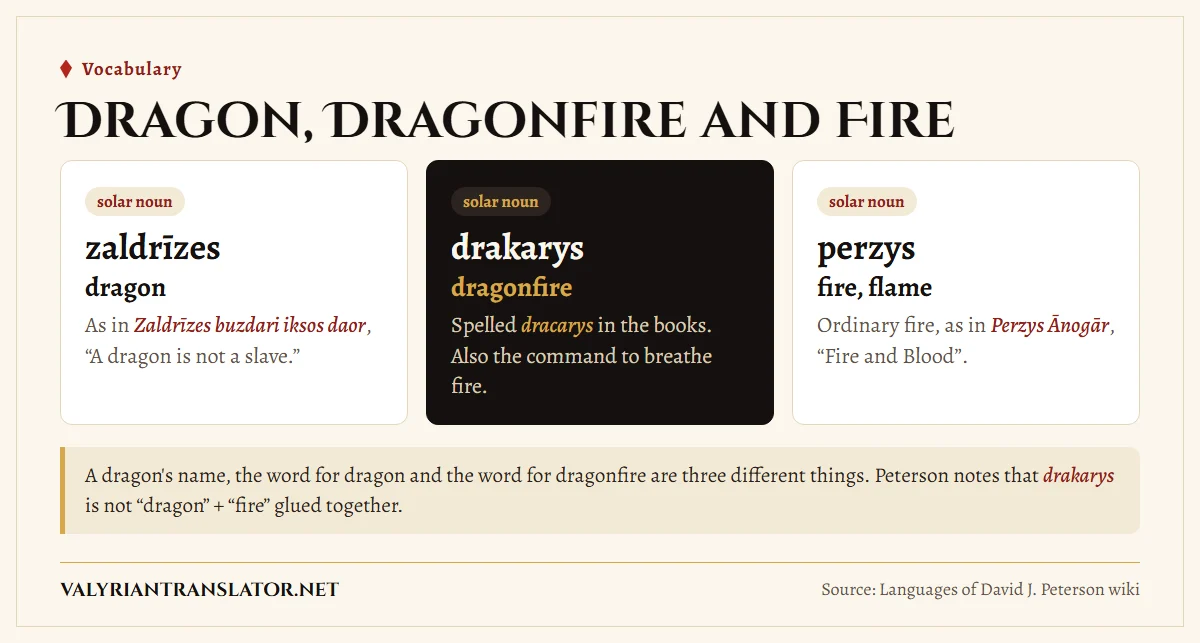
David J. Peterson documents zaldrīzes as the High Valyrian word for dragon. One well-known example appears in the dialogue:
Zaldrīzes buzdari iksos daor.
The expression is translated as "A dragon is not a slave." Peterson explains that buzdari in this particular sentence comes from Astapori Valyrian, rather than High Valyrian. You can read his explanation in the original language commentary, or type the sentence into our High Valyrian translator to see each word.
What Does Dracarys Mean?
Dracarys, also written as drakarys in Peterson's reference material, is associated with dragonfire. It is the famous command used to instruct a dragon to breathe fire.
Although the word is closely connected with dragons, it should not be used as an interchangeable translation for every dragon-related concept. A dragon's personal name, the word for dragon, and the word for dragonfire are different things.
The High Valyrian reference grammar and lexicon are useful resources for checking documented vocabulary.
Can a Dragon Name Generator Create Authentic High Valyrian Names?
A fantasy name generator can create names inspired by the sound of the Valyrian world. However, generating a name that resembles Balerion, Rhaegal, or Vhagar does not make it an authentic High Valyrian word.
A genuine language-based name requires more than similar-looking letters. Its spelling, word formation, and meaning must be supported by documented linguistic material.
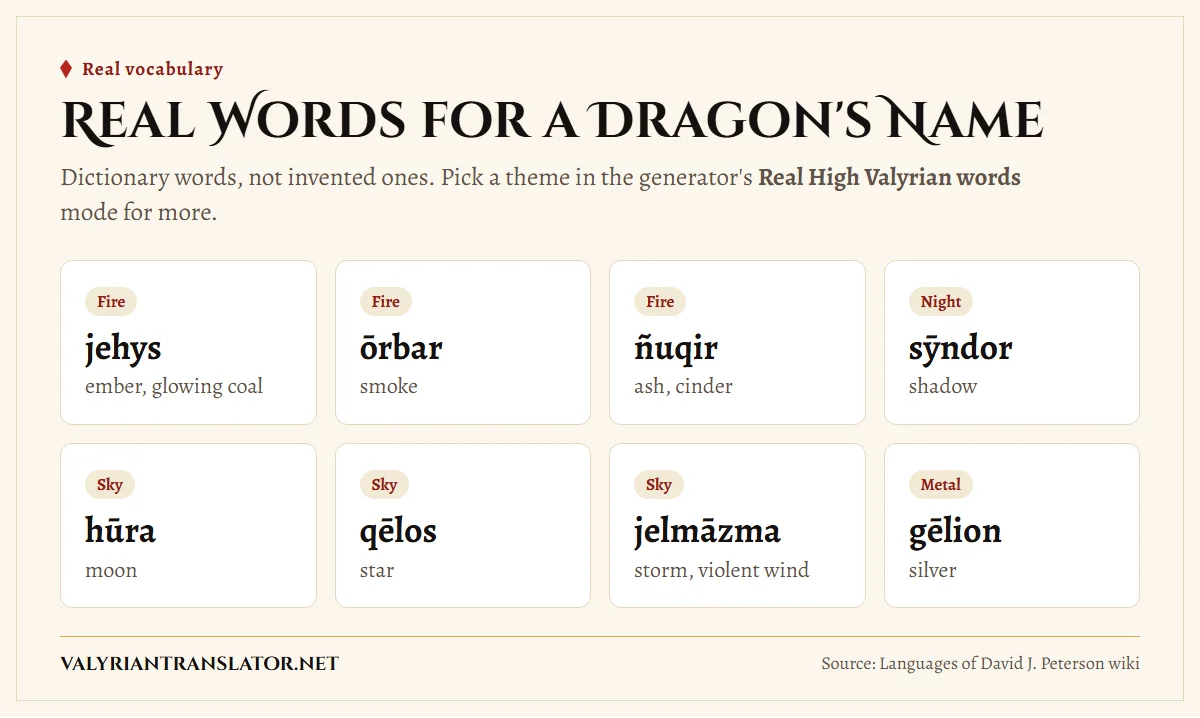
For this reason, treat newly generated names as original fantasy creations unless an authoritative source confirms otherwise. If you want a name with a real meaning, switch the generator to Real High Valyrian words: every result there is a documented dictionary word, shown with its English meaning.
Dragon Names for Role-Playing Games and Fantasy Characters
Dragon names are useful in more than television and novels. They are also popular in tabletop games, fantasy role-playing adventures, gaming communities, and original worldbuilding projects.
Dungeons and Dragons Characters
A dragon name can help establish the identity of an important creature in a Dungeons and Dragons campaign.
Dungeon masters may need names for ancient dragons, powerful enemies, dragon companions, or legendary creatures that appear only once in a campaign.
Consider the dragon's alignment, personality, abilities, and relationship with other characters before selecting a name.
Fantasy Novel Writing
Writers can use dragon names to make their fictional worlds more consistent.
For example, dragons belonging to the same ancient family might follow a recognizable naming style. Other groups could use names connected with their geographical locations, cultural traditions, or religious beliefs.
Maintaining consistent naming conventions helps readers distinguish different dragon families.
Online Gaming and Character Profiles
A dragon name can also work as a gaming username, character identity, or fantasy profile name.
For these purposes, shorter names are often convenient because they are easier to remember and type.
Tips for Creating Your Own Dragon Naming System
If you are developing an entire fantasy world, consider creating rules that apply to all its dragons rather than naming each creature independently. Here are some useful approaches:
- Create a naming culture: Decide whether dragons are named by their riders, families, kingdoms, or another group.
- Establish recurring sounds: Choose a small collection of sounds that help names from the same region feel related.
- Use historical references: Connect important names with ancestors, legendary creatures, or major events.
- Consider pronunciation: Avoid creating names that are unnecessarily difficult to say or remember.
- Keep meanings separate from appearances: A name that sounds ancient does not automatically have an ancient linguistic origin.
- Record your decisions: Keep a list of established names and naming rules so that your fictional world remains consistent.
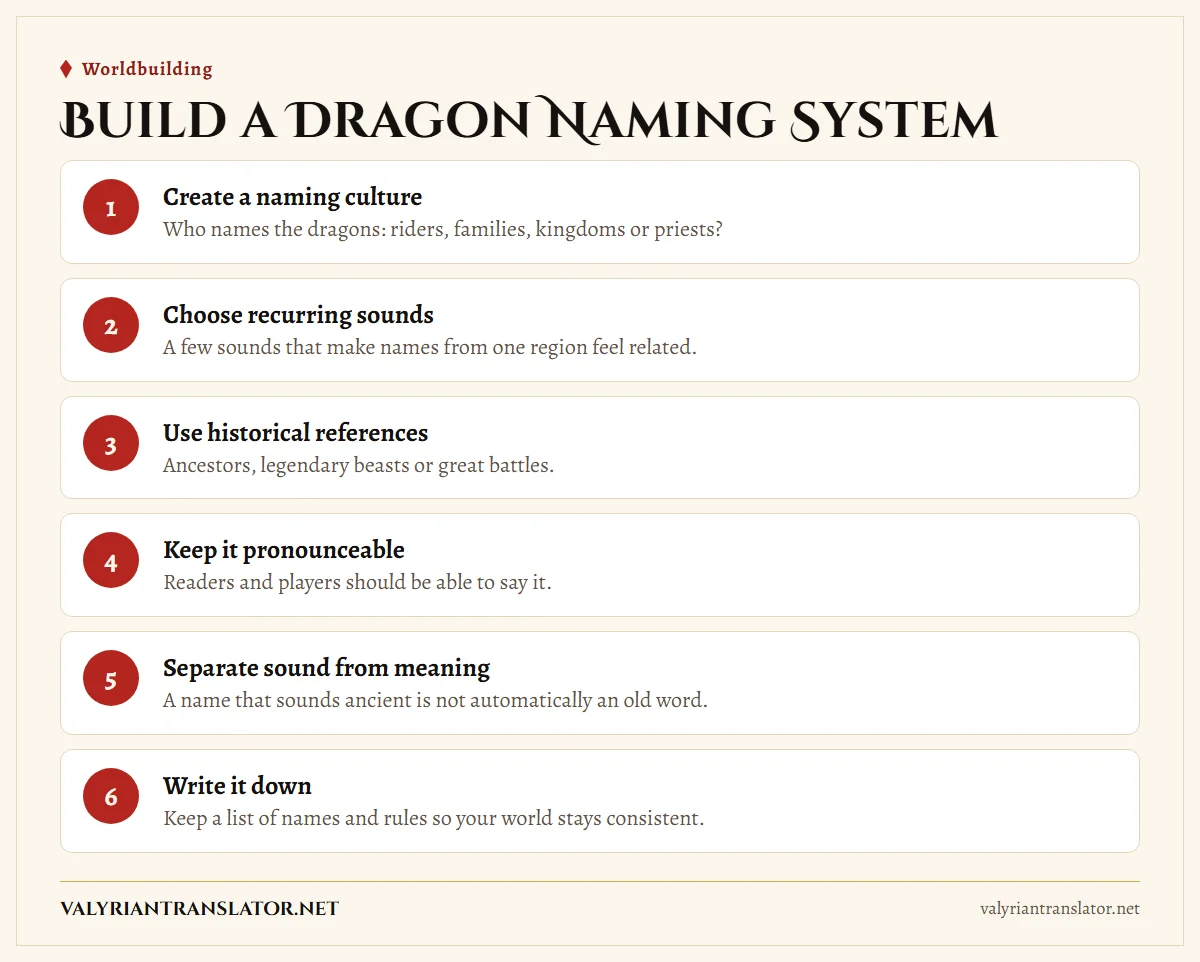
These principles can make a collection of original dragon names feel like part of one coherent fictional culture.
Frequently Asked Questions
Conclusion
A dragon's name is an important part of its identity. It can represent its history, personality, strength, and connection to the fictional world around it.
Whether you are creating an ancient dragon for a fantasy novel, naming a creature for a tabletop adventure, or exploring names inspired by the Targaryen world, a Dragon Name Generator can help you find a suitable starting point.
Explore different naming styles, compare original suggestions, and choose a name that fits your dragon's story. For authentic High Valyrian vocabulary and language references, use documented resources such as our High Valyrian translator rather than assuming that every fantasy-style name has an official translation.